So long sad times
Go long bad times
We are rid of you at last
Howdy gay times
Cloudy gray times
You are now a thing of the past
Go long bad times
We are rid of you at last
Howdy gay times
Cloudy gray times
You are now a thing of the past
Happy days are here again
The skies above are clear again
So let's sing a song of cheer again
Happy days are here again
The skies above are clear again
So let's sing a song of cheer again
Happy days are here again
Altogether shout it now
There's no one
Who can doubt it now
So let's tell the world about it now
Happy days are here again
There's no one
Who can doubt it now
So let's tell the world about it now
Happy days are here again
Your cares and troubles are gone
Lyrics from Happy Days are here again
Today's post was inspired by the the recent release of Gallup's annual "Personal Satisfaction Survey". This year's survey showed a record percentage of Americans felt "satisfaction" with their personal life., a survey they have taken since the late 1970's. See graph below:
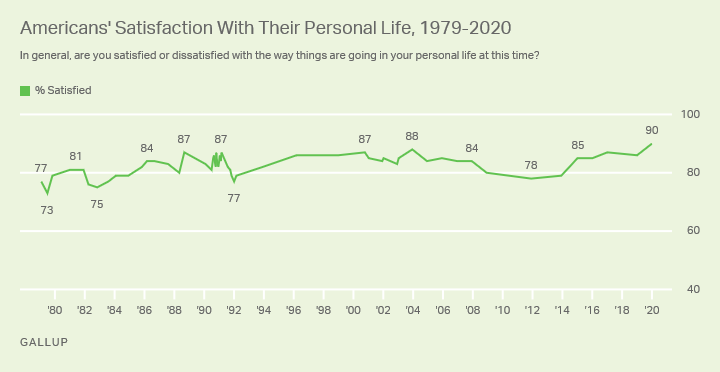
Of course the Republican "Tribe" has already used this as proof positive that Trump will be re-elected. That everyone is so happy because the economy is "booming".
I on the other hand am skeptical of this train of thought, as you will see as I delve into the topic. So here goes:
My last post certainly sounded a dismal tone when I discussed how our tribal warfare was making us such a divided country. Was I wrong? Particularly since it appears that in reality most of us are actually pretty happy, at least with our personal lives.
As I pondered this I thought, "Before I make this a blog post maybe this survey needs further exploration and consideration". So I downloaded the public version and took a look at how the overall survey breaks down in terms of people being satisfied:
Men Women White's Nonwhite Rep Dem Independent
92% 87% 92% 86% 93% 86% 89%
Well based on this analysis ... even democrats are relatively "happy" at least in their personal lives
Before going directly to my "observations" I would like to make a comment about the raw data. When I looked at the sample selection by political leanings, (i.e. actual survey respondents) it raised a flag (at least to me).
Below are the actual survey respondents by political party of those surveyed versus national percentages of registered party affiliations (which I got from Wikipedia):
Republican's polled =32% of survey responses while National Party registration Percentage is 31.3% (spot on).
Independents polled = 41% while Nationally the registration of independents is 25% (way higher polled).
Democrats polled =27% while Nationally the registration of percentage is 43.7% (way lower polled).
So Democrats were under polled by Gallup and independents were over polled.
Now I am no expert on polls but something seems a tad amiss based on raw responses to this survey. Unfortunately I cannot tell if this was an anomaly with this survey either in the past, or just in 2019. Maybe a lot of ticked off democrats simply hung up on Gallup?? Regardless Gallup seems confident about their methodology (see Gallup's survey notes at bottom of blog) so I will use that as justification for being too lazy to research Gallup further on this. Instead I will proceed with my "Observations" assuming that "statistical gobbly de goop" they outlined below has overcome my skepticism.
First a graph of how and what they measured in terms of "personal satisfaction":
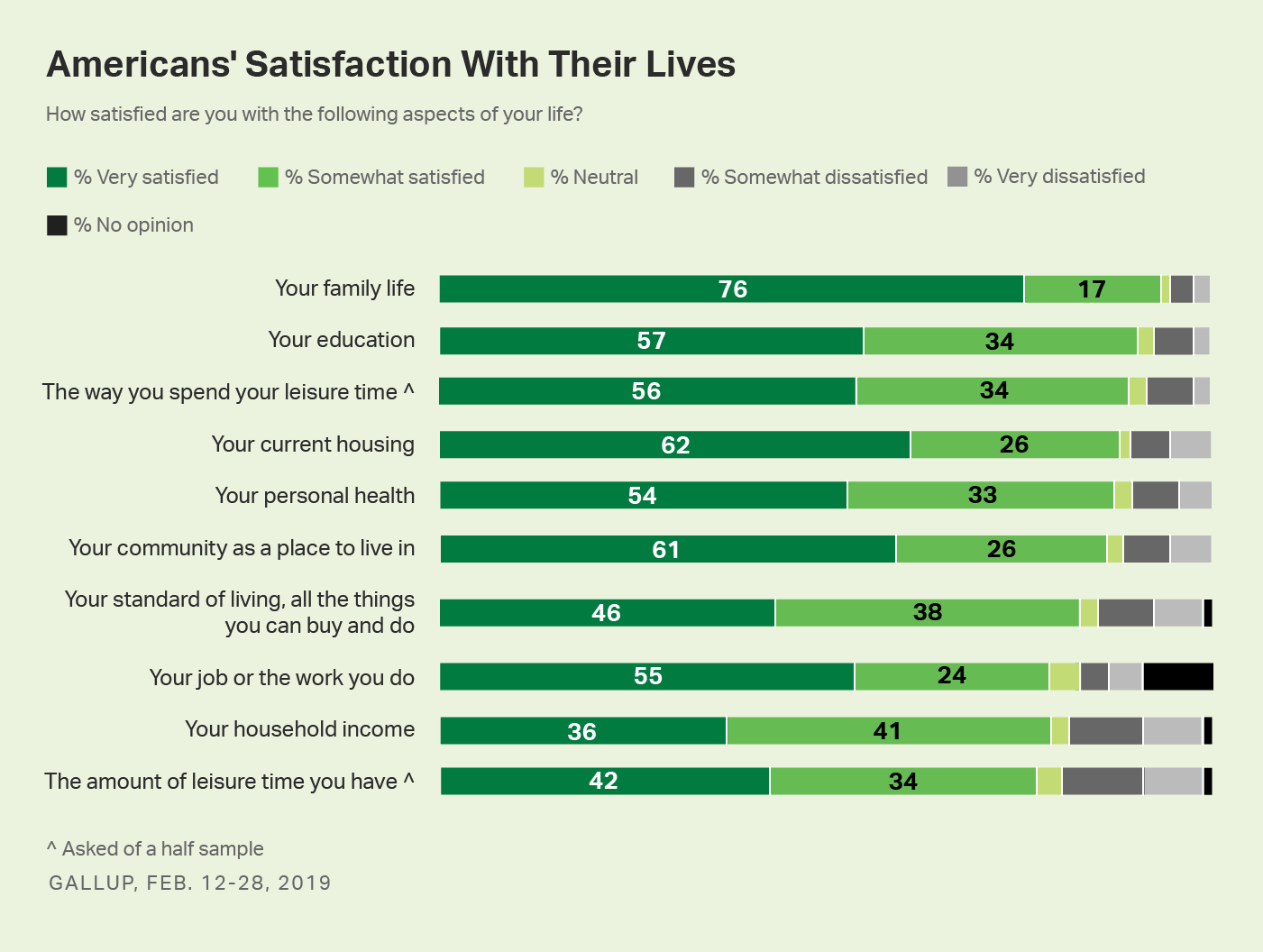
So for "fun" I decided to use a grading system like we had in high school in an effort to create an "American Satisfaction" report card:
1. We get an "A" (excellent" grade over 90%) as respects our feelings on:
Family Life, Educational attainment, and in how we spend our leisure time.
2. We get a "B" (good grade over 80%) on how we feel about our:
Housing, Personal Health, the communities we live in and with our overall "standard of living".
3. We get only a "C" (Average grade over 70%) when it comes to satisfaction with our jobs, and our income.
4. The only thing doing poorly is the "D" (under 70%) for how we feel about the "amount" of our "leisure" time.
In essence we need to work "harder" when it comes to taking more "time off"!
Which reminded me of that famous employment interview question and answer:
Interviewer: "Jim tell me your greatest weakness."
My Answer: "I tend to be to much of a perfectionist at work."
Similar train of thought when the Average Joe says to Mr., Ms, or whatever gender you are or identify as surveyor, is I lack enough "lazy" time.
Regardless what seems clear is that we generally seem pretty happy, and getting happier!
Now frankly from a personal standpoint that would be my general Observation about the typical American. So how does that square with my grim tribal observation on my last blog post?
Well one key is that this happiness with family, and community etc is just that. We live in different communities, and frankly we have become even more "isolated" into these physical and social silos. Our happiness in San Francisco, or New York is likely in communities and families with like minds. Ditto for those living in Batesville Arkansas, and Punxsutawney Pa. Red State Blue State, Urban Versus rural have become more concentrated and more monolithic. So any extra leisure time "Happiness" may come from golf or skiing, but just as likely it may be found in rallying for Bernie, or Trump, or protesting for Sanctuary cities or impeachment, or rallying for "right to Life or 2nd amendment rights'. Heck with social media you don't have to physically leave your house to protest with your friends on twitter. Each side anticipates and believes they are on the right side of history and the joy is working together in that direction...to convince everyone how right we all are. As Haidt termed it, "The Righteous Mind".
In other words we as a nation likely relish our competitive politics and take great satisfaction with it all. Kind of like rooting for our sports teams AKA Them Eagles versus them hated Cowboys. Or we can all just hate Tom Brady and the Pats!
Think I am nuts?
I will end with a clip from a great article last Sunday in the Wall Street Journal on "The Science of Friendship" that has some relevance to all this.
The Surprising Science Behind Friendships
From the Article (which to me was not a "surprise")
Why do we become friends with one person and not another?
There’s this interesting chemistry to friendship. Just like in romance, you are more drawn to some people than you are others. Some of it is very straightforward: You are interested in the same things, you spend time in the same place.
That’s one reason why we are close to relatives, because you
have a head start, you spend more time with them than you do anyone else.
(I highlight in bold the author's own "observation" to which I see as "obvious" oh the lonely world of "scientists")
We do tend to be better friends with people who are more like us.
Having a shared world-view turns out to be important. Scientists looked at all these people in a social network, showed them the same sets of videos and looked at how their brains responded to these videos. They could predict just by looking at the brain processing who was friends with whom. Literally, you hear and see the world more like the people you are friends with.
The big question is: Is it cause or effect? Are you drawn to people who already see and process the world more similarly from the start or do you become more similar? Of course, as with so many things, the answer is probably both.
So I am left with two final questions
1. Regardless of one's world lens can it they still find satisfaction and happiness within a "Tribe" win lose or draw?
2. If true does our divide in some weird way actually make us all "happier"? Even when taking a Gallup survey.
With those crazy thoughts until next time I bid you,
Adieu.
PS.
From this morning's WSJ news:
Michael Bloomberg’s presidential campaign is hiring hundreds of workers in California to post regularly on their personal social-media accounts in support of the candidate and send text messages to their friends about him.
The effort, which could cost millions of dollars, is launching ahead of California’s March 3 primary and could later be deployed nationwide, according to people familiar with the matter and documents reviewed by The Wall Street Journal.
To staff the effort, the campaign is hiring more than 500 “deputy digital organizers” to work 20 to 30 hours a week and receive $2,500 a month, the documents show. In exchange, those workers are expected to promote Mr. Bloomberg to everyone in their phones’ contacts by text each week and make social-media posts supporting him daily, the documents show.

Of course it looks like I would have to do a blog post every day but what the heck 15 minutes a day....for a couple grand a month. Not bad work! I even like the title, "Digital Deputy".
Just gotta find out if my blog qualifies as a "social-media" post, I would think it is!
I can see my happiness index going places!
Results are based on telephone interviews conducted January 2-15, 2020 with a random sample of –1,014—adults, ages 18+, living in all 50 U.S. states and the District of Columbia. For results based on this sample of national adults, the margin of sampling error is ±4 percentage points at the 95% confidence level.
Interviews are conducted with respondents on landline telephones and cellular phones, with interviews conducted in Spanish for respondents who are primarily Spanish-speaking. Each sample of national adults includes a minimum quota of 70% cell phone respondents and 30% landline respondents, with additional minimum quotas by time zone within region. Landline and cell phone telephone numbers are selected using random digit dial methods. Gallup obtained sample for this study from Dynata. Landline respondents are chosen at random within each household on the basis of which member has the next birthday.
Samples are weighted to correct for unequal selection probability, non-response, and double coverage of landline and cell users in the two sampling frames. They are also weighted to match the national demographics of gender, age, race, Hispanic ethnicity, education, region, population density, and phone status (cell phone-only/landline only/both and cell phone mostly). Demographic weighting targets are based on the March 2018 Current Population Survey figures for the aged 18 and older U.S. population. Phone status targets are based on the January-June 2018 National Health Interview Survey. Population density targets are based on the 2010 census. All reported margins of sampling error include the computed design effects for weighting.
In addition to sampling error, question wording and practical difficulties in conducting surveys can introduce error or bias into the findings of public opinion polls. For questions about how this survey was conducted, please contact galluphelp@gallup.com.
______________________________________________

I had no idea we Americans were so happy! I won’t question the Gallup pollsters but a sample size of 1014 seems to leave a few outliers (perhaps). I can’t answer your questions now but perhaps after tonight’s debate...mike may need all the digital deputies he can find!
ReplyDeleteHola Ells
ReplyDeleteWell last night's debate was certainly a circular firing squad.
Two takeaways, Bloomberg busting on Bernie "kill the rich theme" for his three houses in bucolic Vermont. Talk about Carbon Footprints!
Warren's busting Bloomberg on his NDA' which just may result in increased fees for me if I can land a job as a "digital Deputy" for Mike.. Mike can only do it with LOTS of deputies!! Course the downside is a daily "blog" from me to all you guys!!
Anyway as all ways thanks for "weighing in" and commenting!
Jim
Your friends are from such varied backgrounds yet whether it is through length of time you have known each other or that you share a kind attitude, there are obviously reasons you are drawn to each other and your friendship continues. That should make everyone happy.
ReplyDeleteThanks for commenting Ethel!
ReplyDeleteWell some of those friends are from way back and some more recent. Interesting about "time" knowing each other. From the Friends article.
"it takes about 50 hours to go from considering someone an acquaintance to a friend and as many as 200 hours to consider somebody a best friend. You still need extra things, you also need that affinity for someone or that chemistry or that shared worldview. Sometimes we don’t appreciate how much time we have to put in."
Yes friendships take some work and time but it is well worth it!